We are attempting to identify three features of helping behavior:
1. In general, we wanted to find out whether there is a difference in male and female helping behavior. In other words, which sex is more willing to help a stranger in need?
2. Specifically, we want to identify whether men are more likely to help a woman in need; or are they more likely to help a man in need. Similarly, we want to identify whether women are more likely to help a man in need; or are they more likely to help a woman in need. In other words, does sex influence helping behavior?
3. Finally, we wanted to find out whether people's views regarding helping behavior are consistent with people's actual helping behavior. In other words, if sex does play a role in people's willingness to help, are they consciously aware of it?
Summary of data collection efforts:
We decided to design a study that implements the use of both field experimentation and surveys.
The field work consisted of randomly selecting individuals to approach, upon which the experimenter asked the individuals for directions to the Columbia University bookstore. Whether or not the subjects gave us directions was a measure of "level one" helping behavior. We defined "level one" helping behavior as behavior that was relatively easy for the subject to comply with. After asking for directions, we asked the same subject to walk us to the Columbia bookstore. Whether or not the subjects were willing to walk the experimenter, was a measure of "level two" helping behavior. We defined "level two" helping behavior, as behavior that was relatively difficult for the subject to comply with.
The survey consisted of the identical scenario that was implemented in the field experiment, followed by questions designed to test what people believed they would do when presented with the requests.
Who:
Our subjects were 200 randomly selected Columbia University Students; 100 men and 100 women.
When:
We conducted our experiment during both hours of rush time and hours of down time. We define "rush time" as the times of day students are going to and from class. We define "down time" as the times of day students are typically in class; so people on campus are not in a hurry to get to and from class. We varied time of day because we did not want to confound time of day with people's willingness to help.
Where:
We conducted our experiment at three locations on campus: the path leading to the gym, the path leading to the Seeley Mudd building, and the path in front of the Uris business building. We chose these locations because the path was narrow and people could not easily avoid us; also, we were walking distance from the Columbia bookstore. In total 25 men and 25 women were approached who were headed in the opposite direction of the bookstore; while 25 men and 25 women were approached who were headed in the same direction as the bookstore. We took the direction the subjects were originally headed into account because we believed that that would have an effect on their willingness to walk the experimenter to the bookstore. We varied the locations, and the direction the subjects were walking, because we did not want to confound location and direction of subject with people's willingness to help.
How:
There were two parts to our experiment. The first, consisted of a field experiment, designed to test and identify people's actual helping behavior. The second, consisted of a survey designed to identify peoples views regarding helping behavior.
The experiment:
As mentioned above the time of day was varied such that a total of 50 people (25 men and 25 women) were approached during "rush time" and 50 people (25 men and 25 women) were approached during "down time". Location and direction of subject was also varied. The experiment began with a female experimenter who approached 12 men and 13 women. Upon approach, the female experimenter asked two questions. The first question was "can you please tell me where the Columbia bookstore is?". The following question was "can you please walk me to the Columbia bookstore?" The second day of the experiment the time of day was switched and the same female experimenter approached 13 men and 12 women asking them the same two questions. Each subject was randomly selected every three minutes. After three minutes, the first male or female the experimenter saw, she approached with the questions. After 50 people were approached by the female experimenter, the male experimenter followed the identical procedure until he had approached 25 men and 25 women. The experiment took a total of four days to conduct.
The survey:
The survey consisted of a scenario identical to the experiment, followed by eight questions attempting to uncover what the subjects believed they would do upon approach. 50 scenarios suggested that the person was in a rush; while the other 50 scenarios did not mention that the person was in a rush. Every three minutes, at various locations, we randomly selected people to fill out our survey. 25 men and 25 women received the "in a rush" survey while 25 men and 25 women received the "not in a rush" survey. We did this so the conditions could be as identical to the ground experiment conditions.
By the end of the field experiment and the survey we had a total of 200 subjects; 100 men and 100 women.
Implementation of study protocol:
Positive analysis:
Our study was designed in such a way that it took into account the random selection of subjects. We strictly adhered to the random selection technique, giving every person in the population an equal chance of being selected for our study. We believe that because we adhered so closely to the random selection procedure, we were able to reduce bias such that our results would neither consistently over estimate nor consistently underestimate the population parameter. We also used a total sample of 200 people. Using such a large sample size, we believe that our results can fairly estimate the truth of the population as a whole. By varying location, direction of subjects, and rush time versus down time; we believe that our study reduced the effects of confounding variables. For example, if we approached only people headed in the direction of the bookstore, at 9:00 am every day, and near the engineering building every day; and found that 60% of both sexes were willing to walk us to the bookstore. A critic of our study could rightfully challenge our results and say that only morning people, who were engineering majors, headed in the direction of the bookstore, are likely to go the "extra mile" and walk the experimenter. The critic could argue that it is something about these specific people that make them more likely to walk people to the bookstore. Our results would confound with time of day, location, and direction of subjects. We would not be able to generalize our results to the entire population. We controlled for such confounding effects.
Negative analysis:
Problems with our field experiment included nonresponse bias. We encountered two people who would not stop to listen to our question. Thus, the randomly selected individual would not cooperate. Another possible problem with our field experiment was that it was not a double- blind study. Although the experimenter was instructed to ask each individual the same two questions, the experimenter may have in some (perhaps unconscious) way behaved differently to each of the subjects. Perhaps the experimenter smiled more to one subject than to another. This unconscious positive cue could influence whether or not the subject complied with the requests. Hopefully, selecting a large sample helps control for these possible varying cues.
Problems with our survey included wording of questions. Some people were confused with the scale that we used. We marked number one likely and number nine as unlikely. Some people were confused with this numbering system. Also, Many people (more men than women) inquired about the physical attributes of the person in need. Perhaps our questions were not as detailed as they could have been. Another important problem with our survey was response bias. We attempted to reduce this effect by including distracter question, as well as refusing to inform the subjects of what the survey was attempting to uncover until after they had filled it out; the respondents may have lied so they could appear more helpful than they would be in reality. Another problem with our survey was nonresponse bias. Although every person was randomly selected every three minutes, in varied locations, several people refused to take our survey. This introduces bias into our survey. Perhaps people who agree to take a survey are in general more willing to help than those who refuse to take surveys.
Unexpected difficulties:
Randomly selecting 200 people, requires more time and effort than was originally expected. Coordinating three minute intervals, recording the results, and (as the experimenter) attempting to behave exactly the same to each individual was extremely difficult. After having done the process over and over it became easier but, it took a couple of trials before we got our strategy perfected. Another unexpected difficulty was our feelings toward approaching strangers. People can be intimidating at times. We were not selecting people out of a crowd who looked "nice". We randomly selected people, and that meant people who did not appear as "nice" were equally as likely to be chosen. It was difficult to attempt to behave identically to each varying individual subject.
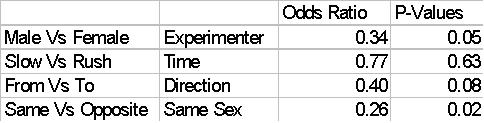
Our fist general topic of study is whether females or males are more likely to help a stranger in need. Given both sexes receive identical treatments; this means that a higher percent of females or males will agree to both requests. The results from our ANOVA table reveal that there is no significant difference in helping behavior by sex. In other words, both males and females are equally as likely to help a stranger in need.
Our second and more specific topic of study is whether people are more or less likely to help a stranger of the opposite sex. If people are more willing to help the opposite sex, one should expect significant association between gender and helping behavior. Here we set up a two-way table, which is a natural way to display association between variables. The results from our chi-square test on association indicate that in fact, there is a significant association between gender and helping behavior; such that people are more likely to help a stranger of the opposite sex (p<.01).
Here are the results from the easy task (question 1):
Here are the results from the hard task (question 2):
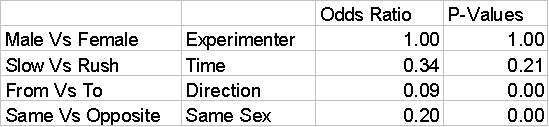
As is evident from the data tables (above) we see that the time of day variable is not significant for question one however, it is significant for question two such that; people in a rush are less likely walk the stranger to the location in question. Interestingly, being in a rush did not deter the subjects from helping when the task was easy. Direction was significant for both question one and question two such that; people walking away from the bookstore were less likely to help than those walking toward the bookstore.
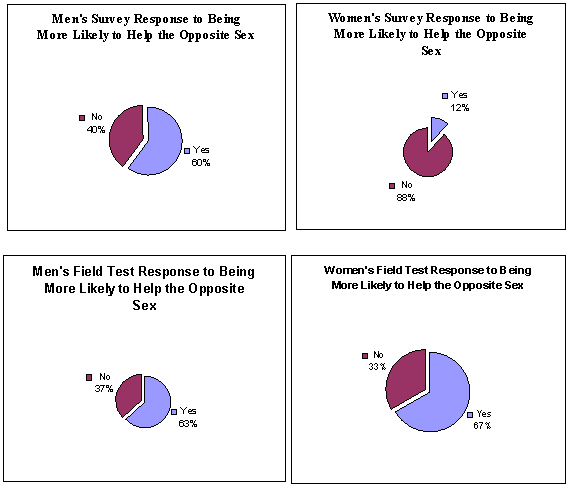
Our final topic of study is whether people's beliefs regarding their own helping behavior is consistent with their actual helping behavior. Here we employ the analysis of the survey, and compare it with the data from the actual field experiment. We now have data to prove that people are significantly more likely to help the opposite sex but, are people aware of their biases? Our survey results reveal two important things: Firstly, we find that both men and women overestimate their willingness to help a stranger in need. In other words, people believe that they are more helpful than they actually are. Second, the survey revealed that men are consciously aware of their sexual biases. 60% of men believe that they would be more likely to help a stranger of the opposite sex. The actual data reveal that in fact, 63% of men helped a stranger of the opposite sex. Our survey reveals that women however, are unaware of their sexual biases. Only 12% of women believe that they would be more likely to help a stranger of the opposite sex. The actual data reveal in fact, 66% of women helped a stranger of the opposite sex.
Do our results agree with what we expected?
For the most part our results do agree with what we had originally expected. We were surprised however, that we did not find an overall difference in helping behavior by sex. We thought that one sex would be more likely to help than the other. Particularly, we speculated that men would be the more helpful sex. We went into this project assuming that there would be a strong association between genders and helping behavior. We did not however, expect to attain the level of significance that was revealed. Closer analysis of our other variables reveals no surprising results. It seems to make sense that people in a rush will help less than those not in a rush. Likewise, it seems likely that people who are walking towards the location of interest would be more willing to comply with the second request. As far as what our survey would reveal, we expected that both sexes would not be aware of their own sexual biases. The fact that men were greatly accurate, and women were greatly inaccurate was a surprising result. Upon analysis, we seem to agree that men and women are both more willing to help the opposite sex; however, men do so with conscious intention while, women do so with perhaps unconscious intention.
Do our results agree with studies conducted by other researchers?
Studies have found that in general, males are more likely to help a stranger in need than are females. Also, females are more likely to receive help than are males. These results were found through several experiments. One such experiment consisted of a male and female experimenter who (on separate occasions) entered an elevator, and dropped coins on the floor. The helping behavior of people in the elevator was recorded (Dabbs and Latane, 1975). The results from this study differ with our results. We found overall, that there is no significant difference in helping behavior by sex. The experiment by Dabbs and Latane however, differ from our experiment in that picking up coins on a floor requires little effort from the subjects; whereas, our experiment incorporated an easy and a hard level of effort required by our subjects. We did find however, that the female experimenter received more help on the easy request for help; this would concur with the research of Dabbs and Latane.
Will our results be consistent in other helping behavior situations?
We believe that our results will stay valid even if the request for help is different. We believe that it is not the specific task that causes people to deny or comply with the request; rather the degree of effort required by the subject. For example, if we conducted the identical experiment but dropped a piece of paper in front of the subject this would be analogous to question one (little effort). Likewise, if we then asked the subject to carry a heavy box for us to a nearby building, this would be analogous to question two (great effort); we would expect similar results.
Will our results generalize to other populations?
We are not convinced that people in other populations will show the same amount of help as was revealed by this study. For example, perhaps Columbia students are more (or less) helpful in general than other people in the population. Perhaps, there is something about students that causes them to be more (or less) helpful than people who older, married, or work full time jobs…etc. However, we believe that the tendency for people to help the opposite sex more will be consistent among all populations.
What did we learn about research?
We learned several things about research. The first thing we learned is that proper research takes immense organization and thought. From the research topic, to the data collection and analysis; every step requires a lot of time and consideration. Furthermore, we learned that being imaginative can generate interesting and useful results. Originally, we tried to keep everything simple; looking back we are now grateful that we were advised to be creative.