The Upper Paleolithic Art Debate
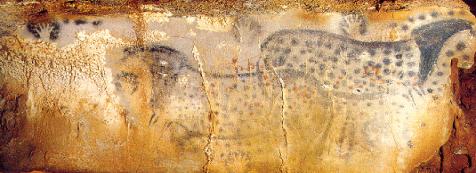
Why are material forms of representation so useful or desirable?
Anthropologist Annette Weiner argues that because objects endure
beyond a single human life they can play a critical role in social reproduction
and continuity. Objects have histories
that link them to their ancestors, a fact that imbues them with political
authority that words and actions lack.
In addition they are also highly visible and interpretable given a
shared system of meaning and have the effect of communicating not only
intra-group distinctions but regional affiliations and group membership as
well. Thus, art is able to perform the
important social function of information exchange. It can affect the successful replication of social groups, and
its distribution in space and time can, in turn, be affected by selective
pressure.
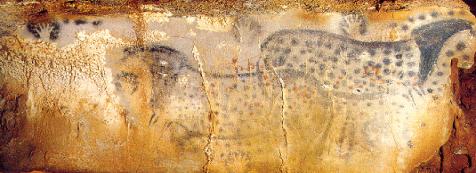
What does this art mean?
The function or purpose of art in the
Paleolithic remains a subject of debate.
Some scholars see the human and animal representations as evidence of
the use of magical rites to ensure success in hunting or to guarantee
fertility. Others have suggested that Paleolithic
artists' accurate representations of animals' coats may be an early attempt to
produce a seasonal notation system. Yet
another viewpoint disregards utility altogether and sees the art of the Paleolithic
people solely as an outgrowth of a basic human need to creatively record and
reproduce aspects of the surrounding world, or “art for art’s sake.”
Whether early art is explained as ritualistic hunting magic; metaphors
for gender, fertility, and sex; origin myths; ethnic or social boundaries; or time-factored
symbol systems, clearly no one correct answer exists. However, the explosion of art in the Upper Paleolithic certainly
represents an initial awakening of the human creative spirit and indicates a
change in the way people regarded themselves and the world around them.